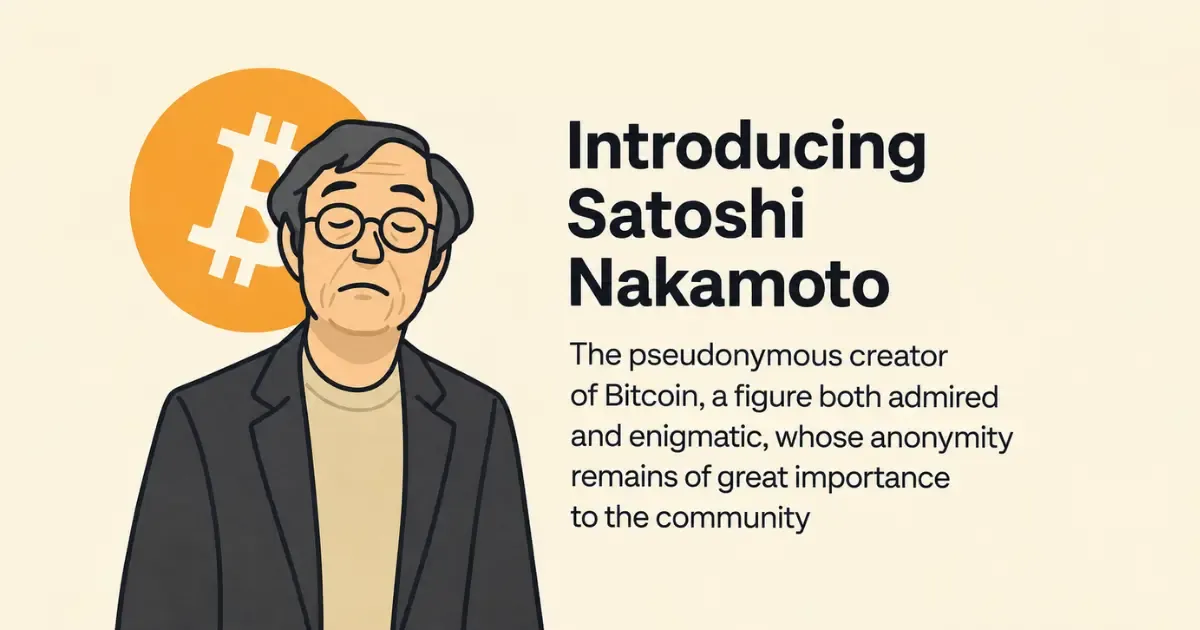
Introduction: The Enigma of Satoshi Nakamoto
Few figures in the history of technology have sparked as much intrigue, speculation, and reverence as Satoshi Nakamoto. This pseudonym, which signed the famous Bitcoin whitepaper, represents not just a person, but an entire revolution. The decentralization of money, the power of cryptography, and financial sovereignty are concepts that, while common today, were made possible thanks to their visionary intervention.
What’s fascinating about Nakamoto isn’t just their invention, but their disappearance. Since 2011, nothing has been heard from him, her, or them. Who were they? Why did they vanish? Does it really matter? These are questions we’ll explore in this article, but above all, we’ll understand how their legacy marked a before and after in the history of the internet and the financial system.
The Origins of Bitcoin and the Digital Revolution
It all started in 2008 when Nakamoto published a technical document titled “Bitcoin: A Peer-to-Peer Electronic Cash System”. This paper described a decentralized electronic money system that eliminated the need for intermediaries like banks or governments. The idea, though simple on paper, represented a radical break from centuries of financial structure.
If you want to truly understand the spirit and vision behind this technology, I highly recommend reading the original document. It’s a piece of internet history that changed the rules of the game forever. You can read the original version here: Bitcoin Whitepaper (Original in English).
The real game-changer was the implementation of the system. With proof-of-work and the creation of the blockchain, Nakamoto solved the historical “double-spending” problem, one of the biggest barriers to digital money.
I first got interested in Bitcoin in 2014, but it was in 2016 when I decided to research it thoroughly. Upon discovering Satoshi, I understood that they hadn’t just created a cryptocurrency; they had given us the first form of decentralized digital ownership in internet history. That blew my mind. It wasn’t just about money, but about individual control over assets in a global environment.
Nakamoto’s Legacy: Beyond the Code
Talking about Satoshi Nakamoto means talking about much more than a whitepaper and a few lines of code. Their impact is measured in innovation, but also in philosophy. For many, Nakamoto embodies the values of freedom, anonymity, and resistance against the traditional financial system.
Thanks to their invention, today there are thousands of cryptocurrencies, decentralized platforms, and a parallel economy that is redefining how we understand value, ownership, and trust. Nakamoto planted a seed that blossomed into the crypto economy.
But their decision to disappear also left a profound mark. By never claiming public authorship, nor moving a fraction of their Bitcoins (over 1 million), their legacy remained free of personal interests. As a community, we learned to value anonymity as a strength. At first, we all wanted to know who they were. Today, many of us understand that not knowing is one of the greatest blessings of the ecosystem.
Theories About the Identity of Satoshi Nakamoto
Since their disappearance, the internet has generated an avalanche of theories to unmask Satoshi. Some names that constantly come up are:
- Hal Finney: The first recipient of a Bitcoin transaction and a key collaborator.
- Nick Szabo: A cryptographer and creator of the “bit gold” concept.
- Dorian Nakamoto: A Californian engineer whose name matched, but who denied any involvement.
- Adam Back: Inventor of Hashcash, a technology used in Bitcoin’s proof-of-work.
- Craig Wright: An Australian businessman who claims to be Nakamoto, without conclusive proof.
Of all these theories, the only constant is the lack of verifiable evidence. And while some might see this as a weakness, for those of us who understand Bitcoin’s DNA, it reinforces its value.
Craig Wright and the Controversies Surrounding His Identity
One of the most controversial episodes in Bitcoin’s history is Craig Wright’s insistence on proclaiming himself as Satoshi Nakamoto. I first heard about him when his story reached Colombia. The surprising part was seeing how politicians in my country gave him official recognition, declaring that he was the creator of Bitcoin. It was a bewildering moment for the local community.
The Bitcoin community, however, never believed him. Wright has made multiple claims and even filed lawsuits, but he has never offered definitive cryptographic proof, such as signing a message with the private keys of the first mined blocks.
Some of his arguments have been inconsistent, and he has contradicted himself in several interviews. Even so, he continues to give lectures and feed his narrative. What he has managed to do is serve as an example of how ignorance can be exploited by public figures to generate attention, without the backing of verifiable facts.
The Impact of Satoshi Nakamoto in Colombia and the Global Community
Although Bitcoin is a global technology, its influence is especially felt in countries like Colombia. In regions where distrust towards the traditional financial system is high and local currencies suffer recurrent devaluations, Bitcoin represents a real alternative.
When I delved into the Bitcoin community, I discovered that the respect for Satoshi Nakamoto was immense. Not just for their invention, but for having handed power to the world without asking for anything in return. This inspired hundreds of developers, enthusiasts, and activists to follow in their footsteps and promote decentralization at all levels.
The Colombian case also proves that, without proper education, institutions can be manipulated by opportunistic figures. The Craig Wright situation was a lesson on the necessity of digital and financial literacy.
The Importance of Anonymity in the Bitcoin Ecosystem
Nakamoto’s anonymity isn’t just an anecdote; it’s a philosophical pillar of the project. Their disappearance prevented Bitcoin from becoming a tool of personal power. With no “leader” or “foundation” in existence, the network was forced to operate by community consensus from day one.
This has prevented forks driven by individual interests and has reinforced its resistance to censorship and manipulation. Today, Bitcoin is an autonomous system that operates without permission, without borders, and without hierarchies. All thanks to its creator’s foundational anonymity.
In my case, I was very curious at first to know who they were. But over time, I understood that their anonymity was an essential part of the design. If they were to appear, sure, it would be interesting to ask how the idea came about, what they think of the project’s current state… but their absence is also a powerful message: the system is bigger than its creator.
Conclusion: The Mystery that Drives Decentralization
Satoshi Nakamoto is, probably, the most influential pseudonym of the 21st century. Their invention not only gave birth to Bitcoin, but it forever changed the way we understand money, trust, and digital sovereignty.
Their anonymity is not a weakness, but a declaration of principles. By disappearing, Nakamoto allowed Bitcoin to grow unchained, without an owner, and to become a tool of freedom for millions of people.
And even though we may never know who they were, their legacy is alive in every transaction, in every node, in every person who believes in a decentralized world. Personally, it profoundly inspires me to know that someone could hand the world such a powerful tool and simply… disappear.
The mystery remains, but the revolution is underway.
Frequently Asked Questions
Who is Satoshi Nakamoto?
It is the pseudonym used by the person (or group of people) who created Bitcoin and published its original whitepaper in 2008. Their true identity remains one of the greatest mysteries of the internet.
Why is Satoshi Nakamoto's anonymity important?
Their anonymity allowed Bitcoin to grow in a truly decentralized way, without a central leader that governments or corporations could censor or pressure, making the network 100% reliant on the community.
What is the Bitcoin whitepaper?
It is the foundational document published by Satoshi Nakamoto in 2008, explaining the technological architecture (including blockchain and proof-of-work) needed to create a digital money system without banks.