The first time I heard about Blockchain, I saw it as some sort of highly secure database. But over time, I understood that it wasn’t just about storing information: Blockchain is a revolution in how we understand trust, transparency, and data control.
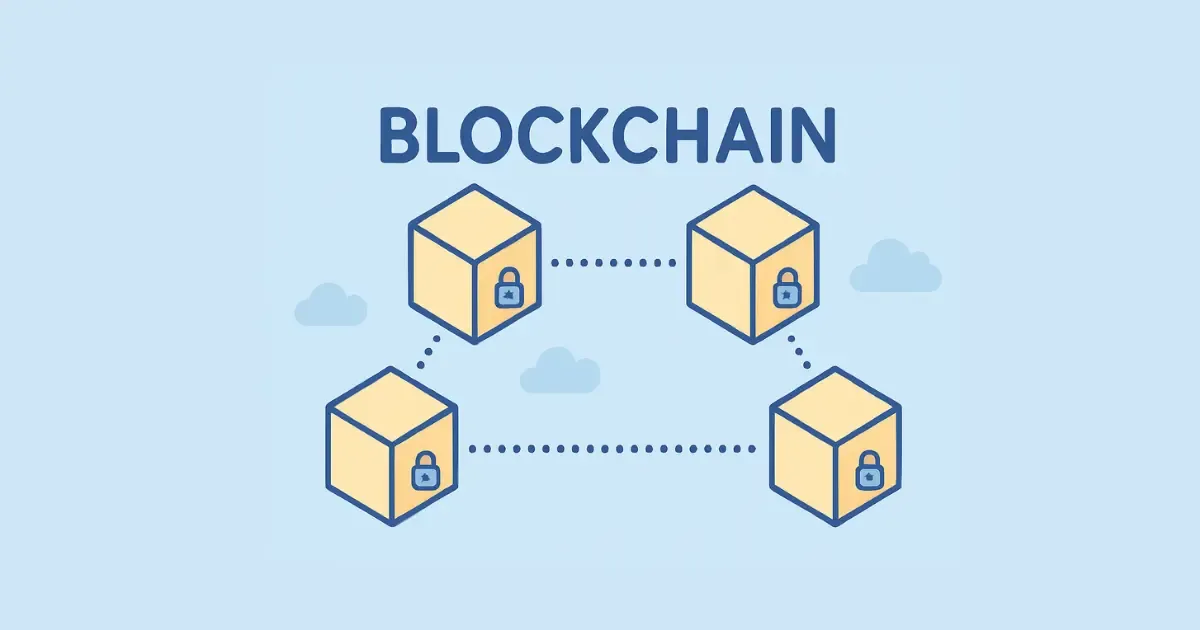
Blockchain is a technology that allows information to be stored securely, transparently, and decentrally, in what is known as a chain of blocks. Each block contains a set of transactions, which once validated and accepted by the network, become part of an immutable ledger. This is a key difference from traditional databases.
The key is that there is no central authority. There is no bank, government, or company controlling the network. The information is distributed among thousands of nodes, which cooperate with each other through a process called consensus to validate the data. Thus, no one can alter already registered information without simultaneously modifying thousands of copies worldwide.
A different kind of database: how does Blockchain really work?
From a technical standpoint, Blockchain functions like a public ledger, where every page is a block containing information (transactions, contracts, data, etc.) validated and secured using cryptographic techniques.
Every time a set of transactions is validated, a new block is created. This block is linked to the previous one through a cryptographic reference called a hash. Hence the name “blockchain”. If someone tried to modify the information in an older block, all subsequent blocks would automatically become invalid.
In simpler words: it’s as if each block were a page in a book. Once written, it cannot be erased or edited. If a mistake is made, it is corrected by writing a new page, but the previous one remains intact.
In my experience, this mechanism of immutability is what truly gives meaning to the Blockchain. It’s not just about decentralizing, but about guaranteeing that no one can manipulate the data without everyone knowing about it.
Decentralization and Immutability: the pillars that change everything
Two concepts are key to understanding the impact of this technology: decentralization and immutability.
Decentralization means that no single node or entity has total control over the network. All participants have a copy of the information and cooperate to keep the network functioning properly. This is what enables transparency and prevents manipulation.
And immutability, as I mentioned earlier, ensures that once something is recorded on the blockchain, it cannot be changed. This feature is critical for applications like financial records, electronic voting, or even product traceability.
From my point of view, if a Blockchain is neither decentralized nor immutable, then it’s not a real Blockchain. That’s why, when I hear about private Blockchains, I always have doubts. Why use a Blockchain if you give up its most important feature?
Public vs. Private Blockchains: Does a closed blockchain make sense?
This is a controversial topic, and in my opinion, private Blockchains contradict the very essence of this technology.
In a public Blockchain, like Bitcoin or Ethereum, anyone can participate, validate transactions, and query the information. It is open, decentralized, and censorship-resistant.
Private Blockchains, on the other hand, are controlled by a company or closed group. Although they use some technical elements of a Blockchain (like hashing or block chaining), they lose their greatest virtue: trustless trust.
That’s why I’ve often said that using a private Blockchain is like trying to build a republic inside a monarchy. Yes, there are votes and rules, but everything ultimately depends on a king.
Ethereum, Solana and the eternal dilemma: speed or decentralization
One of the most interesting debates within the Blockchain ecosystem is the scalability trilemma: security, decentralization, and speed. Achieving all three simultaneously is extremely difficult.
A case I often use is Ethereum. This network has prioritized decentralization since its origins. Every node must validate the transactions, making the network highly secure, but slow. It processes between 15 and 30 transactions per second.
On the other hand, Solana opted to sacrifice some decentralization in exchange for speed and scalability. It can handle thousands of transactions per second, but with fewer validator nodes.
Personally, I believe both approaches are valid. Ethereum is making a long-term bet on a robust and decentralized ecosystem, while Solana is aiming for immediate use cases like gaming, payments, or NFTs. Neither has won the race yet. Blockchain has had over 15 years of evolution, but we are still far from its definitive version.
How are blocks created and what does it mean for them to be immutable?
Each Blockchain has its own consensus protocol, which is the mechanism by which participants agree on what information is valid and gets added to the ledger.
For example, in Ethereum, a new block is created every 12 seconds. That block includes all pending transactions that have been validated. Once created, it is linked to the previous block, and so on.
A useful analogy that has always helped me is imagining each block as a page from yesterday’s newspaper. That page is already written and published. You can read it, copy it, reference it, but not change it. And when today’s page is published, yesterday’s becomes even more solid and credible.
This is how immutability works: the more time that passes since a block was created, the more secure it is. Because every new block reinforces the credibility of the previous one.
Real-world Blockchain applications that are already changing industries
Blockchain isn’t just for Bitcoin or Ethereum. In fact, its potential is much broader.
In the real world, applications are already being seen in sectors such as:
- Decentralized Finance (DeFi): loans, investments, trading without intermediaries.
- NFTs and digital art: unique ownership over digital assets.
- Gaming: unique items and characters, tradable between games.
- Logistics: product traceability, from origin to consumer.
- Digital Governance (DAOs): organizations managed by on-chain voting.
- Digital Ownership: from property titles to Web3 domains.
What’s most impressive is how Blockchain allows the building of systems that are resistant to hacking and centralized control, which is essential in today’s digital age.
Consensus as the key: the role of miners and validators
Going back to consensus, there are several mechanisms. In Bitcoin, Proof of Work is used, where miners compete to solve a mathematical problem. In Ethereum, since “The Merge” upgrade, Proof of Stake is used, where validators deposit funds as collateral to validate blocks.
In both cases, the goal is the same: to ensure that no one can cheat. In my experience, this technical aspect is often overlooked, but it is the key that allows everything to run without needing to trust anyone.
Blockchain beyond cryptocurrencies: DeFi, NFTs, DAOs and more
Although many people associate Blockchain exclusively with cryptocurrencies, the truth is that this technology is giving rise to a completely new digital ecosystem.
I have explored many of these areas, and I can confirm that the potential is real. For example:
- In DeFi you can access financial services without needing banks.
- In DAOs you can participate in collective decisions without hierarchies.
- NFTs allow you to own unique items that you can transfer, lend, or sell.
- And Blockchain-based metaverses are opening up new ways to socialize, work, and entertain.
Furthermore, there are hosting services, betting systems, liquidity aggregators, derivatives, lending protocols, and much more.
Blockchain is becoming the infrastructure of the next generation of the internet.
Current challenges of Blockchain and where it might evolve
Despite its growth, Blockchain faces significant challenges:
- Scalability: how to process millions of transactions without losing decentralization?
- Energy consumption: in some protocols like Bitcoin, mining consumes a lot of energy.
- Usability: it is still complex for the average user.
- Regulation: there is a lack of a clear framework in many countries.
- Interoperability: connecting different Blockchains without friction.
However, there are promising advances: modular blockchains, rollups, sharding, among others. Everything points to the fact that in the coming years we will see a faster, more accessible, and useful Blockchain for everyone.
Conclusion
Blockchain is much more than a technological fad. It is a powerful tool to create more transparent, secure, and democratic systems.
From my experience, the true value of Blockchain lies in its ability to eliminate the need for intermediaries and allow people from anywhere in the world to trust each other without knowing one another.
We are still building, testing, and iterating. But what is already clear is that Blockchain is here to stay. And understanding its essence—decentralization, immutability, and consensus—is the first step to becoming an active part of this new digital era.
Frequently Asked Questions
What is Blockchain?
It is a decentralized and immutable database that records transactions across a global network without relying on a central intermediary.
Why is Blockchain so secure?
Because it uses advanced cryptography and the consensus of thousands of connected nodes, making it virtually impossible to alter or hack the information.
What is the difference between a public and private Blockchain?
Public ones (like Bitcoin) are open and have no owner, whereas private ones are closed and controlled by a specific entity or company.